




Everything You Need to Know About Hell's Half Acre
Located approximately 40 miles northwest of Casper is a unique area of badlands and erosion that opens Pandora’s box to many things. Hell’s Half Acre County Park offers a variety of learning experiences for all ages and some amazing, unique landscapes to view.
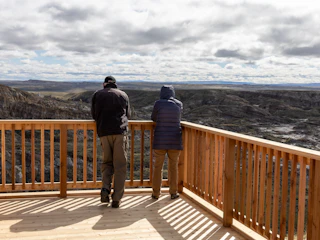
Visit Casper, in partnership with the Natrona County Parks Department, have worked together to revitalize Hell's Half Acre and make the area more enjoyable for visitors to experience. With experienced contractors, the Casper College Geology department, and local history experts, we've brought new life to the park with a boardwalk offering stunning views of the landscape and interpretive signage that outlines the area's geology and history.
If you're planning to visit Hell's Half Acre while in Casper, here is everything you need to know and keep an eye out for while you're there!
- Unique Geology: Learn about the unique geology that makes up the terrain at Hell's Half Acre that was formed over millions of years.
- Paleontology: Early ancestors of modern mammals lived here alongside species that are now extinct!
- Archeology: Some of Wyoming's earliest residents used this area to hunt bison.
- How Did Hell's Half Acre Get its Name?: Coming from an advertising campaign, 'The Devil's Kitchen' was changed to Hell's Half Acre.
- Filming History in Natrona County: Hell's Half Acre looks like another planet, making it the perfect backdrop for a sci-fi film!

Paleontology - What Lived at Hell's Half Acre?
The badlands below preserve fossils of crocodiles, mammals, palm trees, turtles, and other warm-climate plant species, revealing a past tropical environment. Paleoclimate studies suggest this period was among the warmest in Earth’s history.
Fascinating creatures roamed Wyoming 50 million years ago. Among them were Gastornis, the towering and flightless “Terror Bird,’ small primates resembling today’s lemurs, and the tine “Dawn horse,” which stood just 18 inches tall. Early ancestors of modern mammals lived here as well, alongside species that went extinct within a few million years, leaving no descendants.
Archeology - How Have Humans Used Hell's Half Acre?
Humans have lived in Wyoming for at least 12,800 years. During the Paleoindian period (8,000-12,800 years ago), people hunted large game, including ancient bison and Columbian mammoths, which went extinct 12,500 years ago.
In the Early Plains Archaic period (5,000-8,000 years ago), drier conditions led to increased seed and vegetable processing and to hunting smaller animals such as rabbits and hares.
As the climate became wetter (1,800-5,000 years ago), Middle and Late Plains Archaic people conducted large-scale bison hunts, laying the foundation for the Plains Indian bison-hunting culture.
During the Late Prehistoric Period (300-1,800 years ago), the introduction of pottery, bows and arrows, and interregional trade coincided with peak population densities in the region.
Archaeological evidence confirms that hell’s Half Acre was in use from at least 850 B.C., with radiocarbon dating, projectile points, and ceramics aligning with the Late Plains Archaic period.

How Hell's Half Acre Got Its Name
Hell’s Half Acre was donated to Natrona County by the federal government in 1924 as part of a 960-acre federal grant. Throughout the years, the location has had many names, including “The Devil’s Kitchen,” The pits of Hades,” and even “The Baby Grand Canyon.”
The official name, Hell’s Half Acre, came from an advertising campaign by boosters in Casper who wanted to bring more tourists to the area with a roadside attraction. They ordered thousands of picture postcards with the name “Devil’s Kitchen,” but they arrived with “Hell’s Half Acre” on them. Not wanting to lose money, the cards were used, and the name was changed.
The site used to have a motel, gift shop, and restaurant that were privately managed and operated for many decades.
Filming at Hell's Half Acre
A film crew constructed sets and filmed Sony/Tristar’s Starship Troopers in 1996-97.
The sci-fi movie Starship Troopers, based on Robert Heinlein’s novel, was directed by Paul Verhoeven and featured a crew of 300 people. During filming, they brought in 300 extras and infused $4.3 million into Casper’s economy.
The location served as the planets Klendathu and Planet P for the film, and the crew was divided into two units, filming both day and night throughout April and May.
After the movie was filmed, the facility's lessees retired. Another lessee was not found, and the motel and gift shop/restaurant were torn down. Now, partners are in the process of revitalizing the park.
